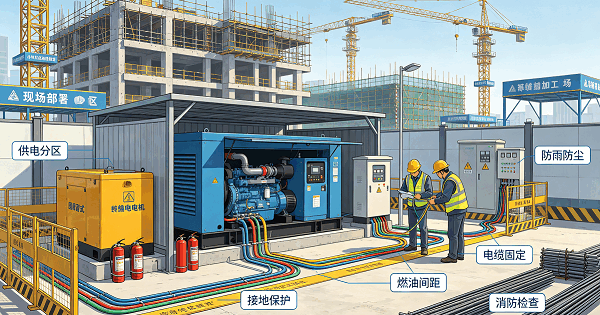
Selecting the right generator set is crucial in modern construction projects. It not only determines the power supply for the site but also directly impacts construction progress and safety. How do you choose a generator set that meets the specific needs of different construction sites? This article provides a comprehensive guide to generator selection, covering technical specifications, installation considerations, maintenance, and market brands.
I. Clarify Power Supply Requirements
Before purchasing a generator set, you must first determine the power requirements of the construction site. Different projects have varying power needs. Therefore, you should conduct the following analysis:
1. List of Electrical Equipment: Make an inventory of all electrical equipment planned for use on-site, including high-power machinery (such as welding machines and concrete mixers) and low-power equipment (such as lighting and power tools).
2. Equipment Power Estimation: Look up the rated power for each piece of equipment and account for the instantaneous power surge during startup when making calculations.
3. Peak vs. Continuous Power: Generator power ratings are typically categorized into peak power and continuous power. You need to determine the required power output based on how the equipment operates to ensure the generator runs stably.
4. Backup Power Margin: To account for potential contingencies on the construction site, it is advisable to select a generator with an additional 10%–20% power capacity to handle unexpected situations.
II. Choosing the Type of Generator Set
Generator sets fall into several main categories based on different operational scenarios and requirements:
1. Diesel Generator Sets: Typically used for high-power applications; they offer good cost-efficiency and durability, feature quick startup times, and are suitable for prolonged use. Their downsides include relatively high noise levels and emissions.
2. Gasoline Generator Sets: These offer lower power output and are suitable for small-scale construction projects or temporary power needs. They are portable and ideal for short-term use, though operating costs are relatively high.
3. Natural Gas Generator Sets: Environmentally friendly and quiet, making them suitable for projects with strict emission standards. However, the availability and supply of natural gas may be inconsistent.
4. Silent Generator Sets: Ideal for use in noise-sensitive areas (such as urban centers) as they have minimal environmental impact, though they come at a higher price point. Selecting the appropriate type of generator set based on specific project requirements ensures efficient construction operations.
III. Technical Parameters of Generator Sets
When purchasing a generator set, carefully analyze the following key technical parameters:
1. Power Output: This is the most critical factor in selection; ensure the chosen generator set meets your specific power requirements.
2. Fuel Tank Capacity: Tank capacity determines the unit's runtime; a larger tank reduces the frequency of refueling, making it suitable for long-duration operations at construction sites.
3. Power Distribution System: Select a suitable power distribution system to ensure compatibility with the voltage requirements of on-site equipment (e.g., 220V, 380V).
4. Cooling System: An effective cooling system improves operational efficiency and extends the unit's service life. Air cooling and water cooling are the two most common methods.
5. Starting Method: Generator sets typically feature either manual or automatic starting. Automatic starting allows for rapid power restoration during unexpected outages, making it ideal for applications requiring continuous power supply.
6. Noise Level: If the construction site is located near sensitive areas such as residential neighborhoods or schools, select a generator set with effective noise control features.
IV. Installation and Operation
Once the appropriate generator set has been selected, the next steps are installation and operation. To ensure proper equipment performance, observe the following points:
1. Site Selection: Install the generator set in a well-ventilated, dry location protected from rain, while maintaining a safe distance from surrounding structures.
2. Foundation and Vibration Damping: Install the unit on a solid, level foundation and incorporate vibration-damping devices as needed to minimize the impact of vibration on the equipment.
3. Cabling and Wiring: Use compliant cables to connect the generator set to the equipment to prevent power loss or equipment damage caused by improper wiring.
4. Regular Inspection and Maintenance: Conduct routine inspections during operation—checking oil levels, battery status, coolant levels, etc.—to ensure the equipment remains in optimal working condition.
V. Conclusion
Selecting the right generator set is crucial for construction projects, as it directly impacts both economic efficiency and the construction schedule. Be sure to comprehensively analyze factors such as power requirements, generator set types, technical specifications, installation and usage, and brand selection. We hope this guide proves valuable in helping you select the right generator set, ensuring your construction project proceeds smoothly and achieves optimal results with greater efficiency.


